Up next in 10



These exercises are strength training for pickleball, but they are also strength training for human function. As a 47 year old physical therapist myself, I want to remain strong and independent into the next several decades of life. These are exercises I can perform daily without significant levels of muscle soreness.
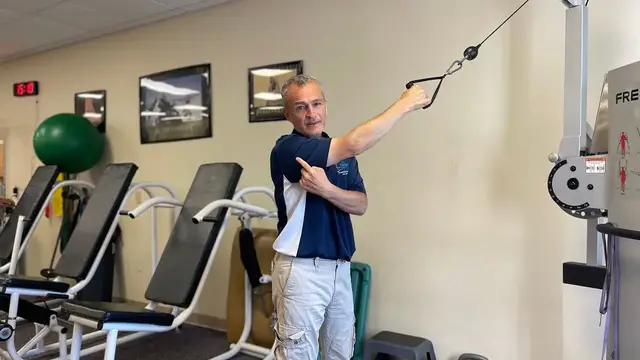
Cable high row, Straight arm pulldown, Horizontal cable pull apart, Horizontal cable pull together, Cable Push-Pull, Cable Squat Row.
About the author:
Hi, my name is Anthony (Tony) Maritato, PT. I am a licensed physical therapist and owner of Total Therapy Solutions. I have specialized in helping clients recover from total knee replacement surgery since 2002 and have created this video to help YOU. I am new to the world of Pickleball and would love to join you on this journey.
Total Therapy Solutions
5900 Long Meadow Dr
Middletown, OH 45005
Show More Show Less View Video Transcript
0:00
Good morning guys, Tony Maritato here, licensed physical therapist, and one of
0:03
the common questions we get in the group on Facebook is what are some exercises I
0:09
should be doing in the gym to help improve my performance on the pickleball
0:13
court? So I'm going to go through five, five of my favorites that really affect
0:17
everybody in a positive way whether you're playing pickleball or just looking for general health and conditioning. Some of my preferred methods
0:26
strength training are either free weights which we'll cover in another video or a basic cable
0:31
machine cable machines are great because it allows me to utilize the resistance in a position that's
0:38
comfortable for my body you know a six foot two 180 pound adult male is going to be different than
0:44
a four foot eight 90 pound adult female so let's take a look at this i always say we're strength
0:52
training we're exercising to improve performance. That is going to be a
0:57
different kind of exercise than somebody who is exercising to increase muscle
1:02
mass to produce hypertrophy. That's different than somebody who's exercising to increase you know absolute strength. So we need to understand that
1:12
while there are metrics for I was a strength coach before I became a
1:16
physical therapist I understand muscle physiology and the mechanics of dosing appropriate exercise. For most normal human beings like us, we're just looking to get fit. We're
1:27
looking to feel better. We're looking to move better on the pickleball court and in life. So I
1:32
usually tell my clients, don't obsess about the weight. Find a weight that's comfortable. Find a
1:37
weight that you can do 8 to 12 repetitions with. If 8 to 12 reps is too easy and you could have done
1:42
20, make the weight a little bit heavier for the next set. If 8 to 12 is too heavy that day
1:48
just lighten it. It doesn't matter what the weight is. It's actually doing the exercise that means
1:53
something to us. So first one is a basic high pull. Now we can do every all of these exercises
2:00
single hand or double hand, straight on or cross body. But to keep it simple, a basic high pull
2:06
I come in here, I back up from the machine so that when my arms are fully extended
2:12
when my shoulders are elevated and forward. I have room to initiate the movement from the shoulder
2:19
blades. So this is called setting the shoulder blade. And then as I pull back, I'm bringing my
2:26
thumbs to the front of my shoulder. If you can't reach thumbs to shoulder, you've got some mobility
2:30
issues and we can address that in a different video But effectively all I doing is full range of motion shoulders elevated anterior I pulling them back and depressing them as I pull thumb to shoulder Like I said I could do a
2:47
bilateral pull because I'm standing and because the weight is pulling me up and
2:52
forward. What's also happening is it's forcing me to find my center of gravity
2:58
to adjust my center of gravity, to use my toes, to use my ankles, my hips, my knees
3:03
the entire kinetic chain is involved in an exercise like this. Now can I lift
3:09
maximum load in this position pulling me up and off balance? Absolutely not, but
3:14
that's not why we're here. We're not here to get a new PR. We're here to strengthen
3:19
and improve the way we move. So again I would do anywhere between 8 to 12 reps
3:26
I'd set a weight appropriately. I would do double arm pulls then I would let go
3:31
and I would do a single arm pull. This is one of the exercises we use quite a bit
3:36
with somebody who's had a rotator cuff repair, with somebody who has had
3:40
non-surgical shoulder pain. They're trying to rehab it. Maybe it's a biceps
3:46
tendinopathy. Maybe it's something like an impingement syndrome and we just want
3:50
to get the shoulder moving. This cross-body single arm pull working through the shoulder blade through the scapulothoracic region and the arm
4:00
best way to do it almost impossible do something wrong but it's a great way to
4:05
get their shoulder moving so that's exercise number one exercise number two
4:09
usually we're gonna lighten the weight because we're gonna use a longer lever
4:14
same thing double hand grip still standing but this time what I'm gonna
4:18
do is I'm gonna brace the trunk and I'm gonna pull straight arm down to the
4:23
front of my pockets and when I say brace the trunk what I mean is I want to
4:28
tighten through the midsection you could call it the core I want to tighten
4:33
through that as I bring the hand down to the front of my thigh my lats are
4:39
working my triceps working my abdominals kind of everything in front of me if you
4:44
imagine me laying on my stomach it's kind of like a plank without movement so
4:49
it's an isometric core or trunk exercise that's got everything working I would do
4:55
double hand I would do again cross body single hand or straight on single hand and the whole
5:02
idea here is I'm training not just the the resistance but I'm training the coordination
5:08
of all of the muscles working together this motion where I grab and I pull down I tightening everything through the core without movement it one of the best ways to just improve Think of it like a tug team If everybody on the tug team pulls at the same time
5:27
you're going to beat a bigger, stronger team that doesn't pull at the same time. We're just
5:32
coordinating the motion and the activity of all of the muscles working together. So those are my
5:37
first two. We've got a high row, we've got a straight arm pull down. Then I'll usually adjust
5:41
the waist down. Now in the regular gym you might not have a machine like this but you most likely
5:49
have some version of a cable crossover. You could do the same thing. You can have two high pulleys
5:55
two medium pulleys, two low pulleys. What we're going to do here, we're going to do this a couple
6:00
different ways. I'm going to grab the two handles in an open position, elbows relatively straight
6:06
I'm going to do a criss-cross either wrist over wrist, elbow over elbow
6:11
If my left was on top for the first set, my right's going to be on top for the second set
6:16
I'm going from a comfortable kind of scaption position. Scaption is kind of right in the middle
6:23
I'm pulling across and relaxing. I'm pausing in the middle. Now you've probably seen people do it with their back toward the machine
6:32
way out in front, pushing down. Again, if I want to lift a maximum load, I'm going to go into that position
6:40
My focus is performance, not maximum load. So I would rather use a lighter weight with longer levers in order to achieve the goal
6:51
So I would do a set of 8 to 12, alternating which grip is on top
6:57
Then I would reverse. So now I'm starting in a crisscross position where I was finishing before
7:03
That's where I begin. and now I'm pulling apart. Now because of the nature of the cables, I would have to keep one
7:10
hand on top, but if I'm going to do eight reps, I'll do four with the right on top, then I'll switch
7:16
and I'll do four with the left on top. And my goal is full scapular protraction to full scapular
7:25
retraction. I'm trying not to get a lot of compensation. I can stay in that nice athletic
7:31
position, kind of weight on the balls of the feet, knees are a little flexed, hips are a little flexed
7:37
stomach is tight, I'm pulling apart, and then letting it crisscross back together. You can
7:43
imagine how this might be a backhand stroke, whereas the first one is a forehand stroke
7:49
A variation on this is I go one cable in each hand and I go into a rotational push pattern I would do a set facing one direction without letting go of the handles I would do a set facing the other direction So I getting that reciprocal through the
8:08
trunk, my feet, my knees, my hips, everything is working together to generate that rotational
8:15
force. Again, you can understand how that's going to translate onto the pickleball court
8:20
And then the last in the series is going to be a low either lunge or squat row
8:29
So I'll come down, I'll grab the handles, I'll back up a little bit so I have plenty
8:32
of room. There's going to be an imaginary chair behind me. And all I want to do is I start with my thumbs at my lower ribcage
8:41
As I sit, I reach forward. As I stand, I pull back
8:47
Now I'm a big advocate of full depth squats. So I'll come all the way down sitting on my heels, come all the way up, thumbs to my lower ribcage
9:00
What I am ideally doing is the line of the cable travels through the line of the forearm
9:06
So I'm not in this position, which now this turns more into a rotator cuff exercise, but
9:12
in this position where the pull is coming from the shoulder blade, the
9:18
posterior delt, all the way through the back of the arm. Once I break that line
9:24
of pull, now either I turn it into internal rotation or external rotation. I
9:29
just want a straight arm pull. That's all I'm looking for. So we could do a set of
9:34
8 to 12 squat rows. We can do cross body to get a little rotation. We can turn it
9:40
into a lunge either same side leg or opposite side leg there's a huge variety
9:45
of what you can do with a simple cable unit that's going to impact what we do
9:51
on the pickleball court now everything here is pretty much been posterior chain
9:56
in another video I'll go ahead and work on anterior chain so that we can balance
10:01
the program but the big principle here is understanding the difference between
10:07
conventional strength training, conventional power training, and just general conditioning. I'm a big believer in general conditioning. General conditioning can be done every day
10:18
You don't need to take wet rest breaks. When you're finished, you should feel good. You shouldn't feel
10:22
significant muscle soreness tonight or tomorrow morning. You should be ready to go again
10:29
It's energizing because I believe the more activity we can get in a 24-hour period, the better
10:34
if I come into the gym and I completely wipe myself out
10:38
but then I go lay on a couch for eight hours, that kind of defeats the purpose
#Fitness
#Health
#Sports
#Fitness Instruction & Personal Training