0:00
Good morning guys, my name is Tony Maritato. I'm a licensed physical therapist and in today's video
0:04
I want to talk about one of the most frustrating aspects of the game of pickleball and that's going
0:10
to be your grip strength. Both grip strength, wrist range of motion, finger dexterity, these are all
0:17
components that are going to lead to either success or failure on the court and so I want to share a
0:22
couple of my favorite exercises for anybody who wants to improve the way you can control the paddle
0:28
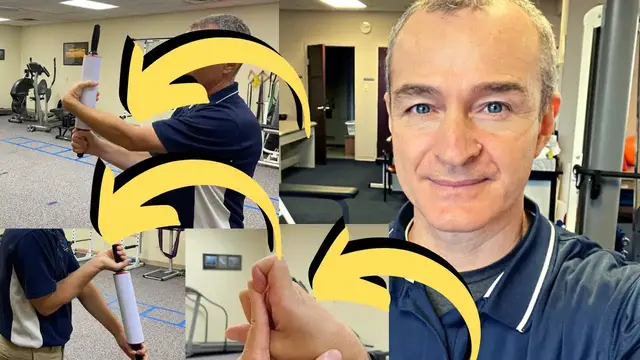
Now, in my hand, you see a typical rolling pin. It could be wood, it could be metal, it could be marble
0:34
it could be whatever you have sitting in the back of the kitchen drawer that hasn't been used for the last 15 years
0:41
I love rolling pins for a bunch of different reasons, and you're going to see a lot of videos on this channel
0:46
of me using the rolling pin for different things. But talking about grip strength, wrist mobility, finger dexterity
0:54
here are my favorite couple of exercises to get started. First, though, I want to talk about what these movements are
1:01
So when my palm is palm up, this would be called supination
1:06
This is referencing the wrist of the elbow, the forearm. Supination, when I turn over, that's pronation
1:13
If I move my pinky if I bend my wrist toward the inside of my forearm that ulnar deviation And when I bend my wrist toward the thumb side that radial deviation So if you have these basic motions right forearm supination
1:32
pronation, ulnar, radial deviation, then of course we talk about gripping itself. Now I am not a
1:40
certified hand therapist. There are some amazing CHTs out there, but basically we want to make sure
1:46
that we can actually grip the paddle. We want to make sure that we can do finger to finger, tip to
1:53
tip, pad to pad. These are different little exercises. And then we're going to take that motion
1:59
and we're going to add a little resistance. Now this is actually a baker's rolling pin. This is
2:04
five pounds, so it's got a little bit of weight to it. I'm going to kind of step back, elbow extended
2:10
I can go into a pronated position, which is also shoulder internal rotation because I've got the
2:17
whole arm moving. I could go to supinated position, which is external rotation of the shoulder
2:24
If I bend the elbow, I kind of take the shoulder out of the exercise. I can go pronation, supination
2:31
If I turn, I can go ulnar deviation, radial deviation. These motions are important. If I
2:38
feel like I not getting enough motion what I like about the rolling pin is the handle allows me to add what we call overpressure So I get the range of motion that I have available and then I add a
2:52
little overpressure to stretch the connective tissue. If I go into ulnar deviation, again I can
2:59
add a little overpressure. If I go into supination, I can grab it and add a little overpressure
3:06
and of course pronation, a little bit of overpressure. When we're talking about wrist
3:12
mobility, for me to grip the paddle effectively, I need to have a little bit of wrist extension
3:19
One way I can work on that is literally just rolling the rolling pin back and forth. So I go
3:27
from a wrist flexed position to a wrist extended position and then I do the same thing on the other
3:34
side. I can hold the rolling pin vertical and work on wrist flexion to wrist extension just around
3:43
the pivot point. And then of course I switch and I work the other side because we want to make sure
3:48
that both sides are equal. Even if you're a right-handed pickleball player, you still want to
3:53
work the left side. And then finally, my last little tip for the fingers themselves is going
3:59
to be working on I going to try to come in close working on the mobility of each individual joint So the way the index finger is kind of structured I want to be able to touch that pad to the base
4:13
I come in here. And even if you can't do it on each finger initially
4:18
with some practice, you should get to the point where you're going to be able to do that
4:24
Now, if you have severe arthritis, you have a rheumatoid arthritis condition
4:28
you have some other reason for not being able to regain the mobility
4:32
what I would recommend as a licensed physical therapist is working on maintaining the mobility
4:38
you have. Some of my clients will develop these adhesions into the palm so they can't fully open
4:45
or extend the fingers. Again, this is something that can be worked on if you're dealing with a
4:50
condition like trigger finger, of course, have an evaluation, talk to a medical specialist so that
4:56
you know what kinds of things that you can and can't do. Carpal tunnel is another common
5:01
condition if many of my patients have had a carpal tunnel release we want to make sure that we assess
5:07
where they are right now but wrist mobility finger mobility grip forearm elbow the list goes on all
5:15
of these things are going to contribute to you enjoying the game of pickleball more frequently
5:21
more often and more deeply simply because it allows you to play longer guys thanks so much
5:27
i'll catch you on the next video