Up next in 10



These ankle exercises for pickleball may help improve mobility and stability problems.
About the author:
Hi, my name is Anthony (Tony) Maritato, PT. I am a licensed physical therapist and owner of Total Therapy Solutions. I have specialized in helping clients recover from total knee replacement surgery since 2002 and have created this video to help YOU.
Total Therapy Solutions
5900 Long Meadow Dr
Middletown, OH 45005
Show More Show Less View Video Transcript
0:00
Good morning guys, Tony Maritatto here, Licensed Physical Therapist and in
0:04
today's video I want to talk about both ankle mobility and ankle stability. So I
0:09
talked to a lot of patients who feel like they have what they call weak ankles or unstable ankles. They feel like when they're on the pickleball court
0:16
they're gonna sprain an ankle or they just don't have the control over moving
0:20
their body around the court to get to those hard shots. So stability is the
0:26
ability to control a joint, in this case the ankle, during movement, during activity. Mobility
0:33
would be going through a range of motion whether it be what we call plantar flexion which is
0:39
pointing the toe, dorsiflexion, pulling back, inversion and eversion are side to side. So first
0:47
three basic mobility stretches that everybody should be doing as part of their warm-up just to
0:52
to make sure they have full range of motion and the ankle is within normal range of limit
0:57
motion requirements. So the first one everybody I'm sure has done in some capacity is just a basic calf stretch
1:05
The heel goes back, the foot stays flat, you can do it with a straight knee to stretch
1:10
the more superficial gastrocnemius, or you could do it with a bent knee to stretch the soleus
1:16
which is the deeper calf muscle. The calf is essentially two muscles kind of combined into one So knee straight for the gastroc this is gonna be a 20 or 30 second stretch Knee bent for the soleus this will be a 20 or 30 second stretch This is pretty common
1:33
The two that I'm going to show you now are less common but just as important
1:38
So the top of the foot, top of the ankle, even into the front of the shin
1:44
This is where I point my toe down, I go into a plantar flex position
1:48
I lean down into it. You can even go down into a lunge position if you want, but I like to kind of keep my body off the ground
1:56
What I'm doing is I'm stretching the muscles along the top of the foot along the lateral aspect of the shin
2:04
I'll hold this position about 20 to 30 seconds and then of course everything I do on one side I'll do on the other
2:11
And then the final is inversion. Now I never stretch into eversion
2:18
which is going like a knock-kneed position, but I do think that there's value
2:23
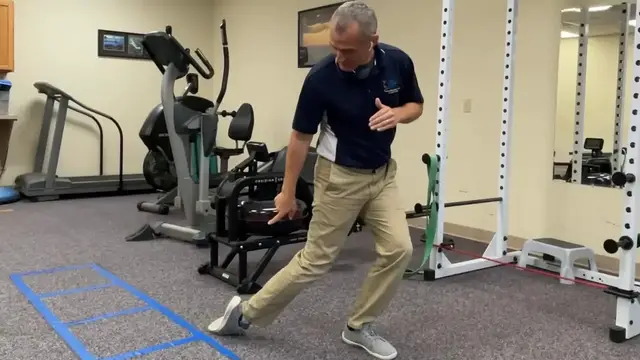
in going into an inverted position. This would be the typical position
2:27
somebody experiences an ankle sprain in. But by being able to go into that position
2:34
and back out under partial weight bearing, so most of my weight is on my back leg
2:39
I've got maybe 20-30% of my weight on my front leg. I'm going into that everted position
2:45
I can control that movement. I can go in and out of that movement this way
2:50
If for some reason I step on a crack or I step on an edge that I not expecting and my ankle wants to sprain or invert there a chance that my body will recognize I already been in this position
3:02
and I can control it. But going in and out of that inverted position I think is an important aspect
3:09
of ankle mobility. So now let's talk about stability. How do we build strength and stability
3:15
control through those same three range of motion. So first one's super easy, right? Before we were
3:22
doing a calf or a gastroc and soleus stretch. So now all we're going to do is we're going to do a
3:27
simple heel raise. If I'm doing both legs, bilateral heel raise pretty easily, then what I would want
3:35
to do is go into a single heel raise. If I don't have the balance and the control, I can touch a
3:41
pole, I can touch the fence, but the goal would be to eventually get to where you can do it without
3:46
holding on. You've got single leg support, the hip, the knee, the ankle. It's strong, it's stable
3:52
through the motion. I would do 20 to 30 single repetitions on each side, one leg at a time
4:00
Then I would look at the second. We did a mobility for the top of the ankle. So now what I'm going
4:05
to do is I'm going to do toe raises. So I go back, my hips go back, my ankles flexed. I can feel the
4:12
muscles along the front lateral shin lateral top of the foot and ankle Those are the muscles that we were stretching the ligaments and connective tissue we were stretching in the mobility phase Now we building stability If I had a step if I had something elevated that would allow me to drop the toe below the heel and come through a full range of motion even better
4:40
this would be the ideal scenario so a curb a bench or anything that you have
4:45
that allow you to drop the toe below the ankle before you lift it again 20 to 30
4:52
reps of that these are high endurance muscles so they should not fatigue with
4:58
20 to 30 repetitions and then finally when we're talking about that inverted
5:03
position what I would do is the same thing originally we were going through
5:08
motion, 20% or less weight or loading through the ankle when we're going for mobility. Now that we're
5:16
going for stability, I'm going to put almost all of my weight on the ankle. I'm going to intentionally
5:21
roll out and roll back in. I want to control that motion. If I feel like I can do it without holding
5:27
on or single leg balance, I roll out, I roll back in. That is a vulnerable position for the ankle
5:34
but it's one in which we need to increase strength and stability to control that, to try and prevent injury
5:41
try and reduce the chances that we're going to sprain or roll an ankle
5:45
So guys, six exercises here. If you have any questions about them, post them down in the comments and I'll see you on the next video
#Physical Therapy
#Sports
#Individual Sports
#Running & Walking